

The Quiet Drama of Black and White Coastal Photography
|
|
Time to read 16 min
Cart
Your cart is empty
|
|
Time to read 16 min
After rain, the shoreline seems to speak in another language.
Wet sand deepens to charcoal. Foam draws pale, temporary lines across the beach. Clouds gather in soft layers above the horizon, and tidal water holds their reflection so clearly that sea and sky begin to blur.
At low tide, shells, coral, driftwood, rippled sand, and marsh grasses become studies in shape and shadow. Color softens. Texture moves forward. The coast feels quieter, yet somehow more intense.
I am drawn to black-and-white coastal photography because it asks me to look past the first impression. Without color leading the eye, I begin to notice the small architecture of the shoreline—the ridges of a shell, the repeated markings of a sea urchin, the folds of coral, the grain of weathered wood, and the changing edge where water meets sand.
Black and white does not make the coast less vivid. It reveals another kind of beauty: one built from form, contrast, atmosphere, reflection, and layer upon layer of texture.
Black-and-white coastal wall art uses tone, light, line, and texture to interpret shoreline subjects without relying on color. In a room, it brings the structure and mood of the coast into view in a refined, versatile way.
That way of seeing inspired the Coastal Black & White Glass Prints collection at Echoes of the Sea.
Why removing color allows coastal form, texture, and mood to take center stage
What shells, coral, sea urchins, driftwood, beaches, and marshes reveal in monochrome
How light, weather, negative space, and tonal contrast shape a strong coastal photograph
Why black-and-white coastal wall art works especially well in rooms with ocean or marsh views
How real, frameless glass adds luminosity, depth, and subtle interaction with light
Ways to display monochrome coastal art as a single statement, coordinated pair, or triptych
Color often speaks first.
Blue water, green marsh grass, warm sand, pearly shells, and cream-toned coral can immediately establish a sense of place. But when those colors disappear, the eye begins to move differently.
A wave becomes a curve of light against dark water.
A sea fan becomes lace.
A nautilus becomes geometry.
A shell is no longer defined primarily by its pearly surface. Its ridges, spiral, contour, and changing bands of light become the subject. Coral reveals an architecture of folds, branches, hollows, and clustered surfaces. A sea urchin becomes a study in repetition and natural symmetry.
Removing color takes away one layer of visual information, but it allows many others to rise.
That is why black-and-white coastal art can feel both quiet and powerful. It does not rely on the expected blues and greens of the shore. Instead, it asks the eye to notice what may have been there all along.
What draws me most to these photographs is the way texture takes center stage.
In the shell, sea urchin, and coral pieces, there is never only one surface. There are smooth curves beside fine ridges, clustered patterns beside folded edges, polished spirals beside porous reef forms.
Without color competing for attention, the eye slows down.
It begins to notice the delicate geometry of a sea urchin shell, the layered structure of coral, the sweep of a nautilus spiral, and the quiet transitions between highlight, shadow, and reflection.
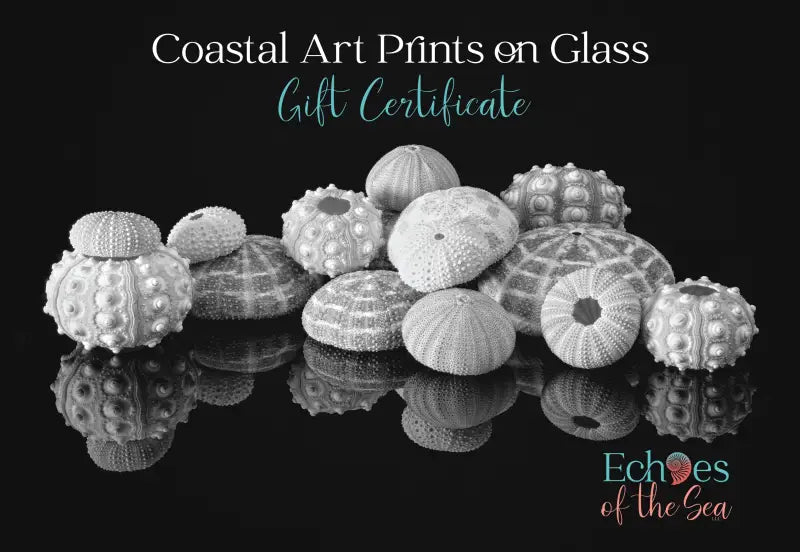
A fan-shaped shell reveals every radiating line. Lettuce coral becomes a landscape of ruffled edges and deep valleys. Cauliflower coral shows its dense, rounded structure. A branching sea fan appears almost weightless beside the solidity of a sea biscuit or Merulina coral.
When I arrange shells, coral, or sea urchins for a still life, I am rarely looking only for perfect specimens. I am looking for relationships.
A smooth spiral beside a porous surface.
A delicate branch beside something solid.
A pale form emerging from shadow.
A repeated pattern interrupted by one sweeping curve.
Those relationships are often easier to feel in black and white because the composition is no longer being carried by color alone.
Black and white does not flatten the coast. It reveals its layers.
That is especially true in close compositions. When a shell, coral form, sea urchin, or piece of driftwood fills the frame, it can move beyond straightforward representation and become almost abstract.
The subject remains recognizable, but rhythm, balance, texture, and shadow begin to matter just as much as identification.
For a closer look at the repeating structures found in shells and reef forms, you may also enjoy Fractals in Nature: Why Shells, Coral, and Nautilus Patterns Feel So Calming.
The shoreline is filled with natural relationships between light and dark.
Bright foam meets deep water. Pale shells rest against wet sand. White coral rises from black shadow. Sunlight breaks through storm clouds. Tidal grasses interrupt smooth reflections, and driftwood creates dark hollows beside silver-gray grain.
Black-and-white photography does not impose contrast on the coast. It reveals contrast that is already there.
Sometimes that contrast is dramatic: shells become sculptural, coral appears carved from light, and driftwood feels architectural. At other times, a marsh or shoreline unfolds in softer layers of silver, charcoal, mist, and reflected sky. Both belong in monochrome—one elemental and bold, the other spacious and meditative.
A strong black-and-white coastal image is not simply a color photograph converted to grayscale. It needs enough form, tonal contrast, and texture to hold the eye without color doing the work.
In monochrome, I begin to notice different things: the way foam lifts against darker water, how light travels across a shell’s ridges, or whether the delicate branches of a sea fan remain visible against the background.
Negative space becomes part of the composition too. A deep black background can give a shell or piece of coral room to breathe. Open sky can make a shoreline feel expansive, while quiet water can strengthen the reflection of grasses or clouds.
Simplicity does not mean emptiness. It means allowing the important forms to hold their place.
In still-life photographs, I often use darkness to isolate texture and shape. In landscapes, I may allow sky or water to occupy much of the frame so the eye can rest before returning to the details.
The strength of the image often lives in that balance between presence and space.
Conditions that may feel subdued in color can become especially expressive in black and white.
Overcast skies reveal cloud structure. Fog simplifies the horizon. Post-storm light separates water, sand, and sky. Flat light can uncover delicate texture that harsh sunlight would overpower.
After rain, wet surfaces deepen in tone and begin to reflect more of the world around them. Sand holds the sky. Marsh water gathers clouds. Shells and coral reveal quieter transitions between highlight and shadow.
In Corolla Dawn, rolling surf, reflective wet sand, and layered clouds create movement across the frame. The pale light near the horizon feels more pronounced because it is surrounded by darker tones.
In Cumberland Island Reflections, marsh water mirrors an expansive cloud-filled sky. With color removed, the landscape becomes a study of openness, stillness, and the delicate line separating earth from atmosphere.
My goal in processing these photographs is not to make every black deeper or every white brighter.
It is to preserve the quiet transitions between them—the soft gray along a shell’s curve, the shadow inside coral, the faint reflection that nearly disappears into the surface below.
The photograph should still feel natural, even when the contrast is dramatic.
Seeing in black and white begins before the photograph is taken.
Instead of asking which colors are most beautiful, I begin to look for the relationship between light and dark. I consider whether a pale shell will separate from its background, whether a reflection strengthens the composition, and whether the subject has enough form and texture to remain compelling without color.
This way of seeing can transform familiar coastal subjects. A shell may become more striking because of its spiral and ridges. Coral may reveal folds and valleys that color once softened. Weathered wood can shift from a shoreline object into something sculptural and almost architectural.
A black-and-white photograph is not simply an image with something removed.
At its best, it is an image in which something else has been allowed to speak.
When color falls away, texture begins to speak.
A room with an ocean, marsh, dune, or open-sky view already holds color, distance, movement, and changing light.
The artwork inside does not need to recreate all of that—or compete with it.
Black-and-white coastal wall art can give the room something different: structure, intimacy, contrast, and a place for the eye to settle.
Close studies of shells, coral, sea fans, sea urchins, and driftwood work especially well in rooms with a view. They bring the coast inward through material and texture rather than through another large field of blue or green.
A monochrome shell study can feel almost architectural against a bright coastal window. Coral adds intricate pattern without adding visual noise. Driftwood brings organic movement while allowing the landscape outside to remain the room’s broadest expression of color.
Black-and-white landscapes can work beautifully too.
A reflective marsh or cloud-filled shoreline can echo the atmosphere beyond the windows without attempting to duplicate it exactly. The relationship feels subtle—not a matched scene, but a shared sense of space, weather, reflection, and stillness.
The view gives one kind of beauty. The artwork gives another.
That is often why monochrome art feels so natural in coastal homes. It belongs to the same world as the view, but it does not demand the same kind of attention.
For more on this idea, read What to Hang When the View Is Already Beautiful.
Black-and-white coastal wall art brings a refined, restful presence into many different interiors.
In a modern coastal room, it adds contrast to warm whites, pale woods, linen, woven fibers, and stone. In a minimalist space, it offers detail without disturbing restraint. In organic-modern and Japandi-inspired interiors, shell, coral, driftwood, and marsh forms connect naturally with tactile materials and quiet palettes.
Monochrome coastal art also pairs easily with color.
Slate blue, charcoal, muted sage, weathered gray, ivory, soft clay, and natural wood can all sit comfortably beside black-and-white photography. Because the artwork itself is neutral, it can remain in place as textiles, furnishings, and accent colors change.
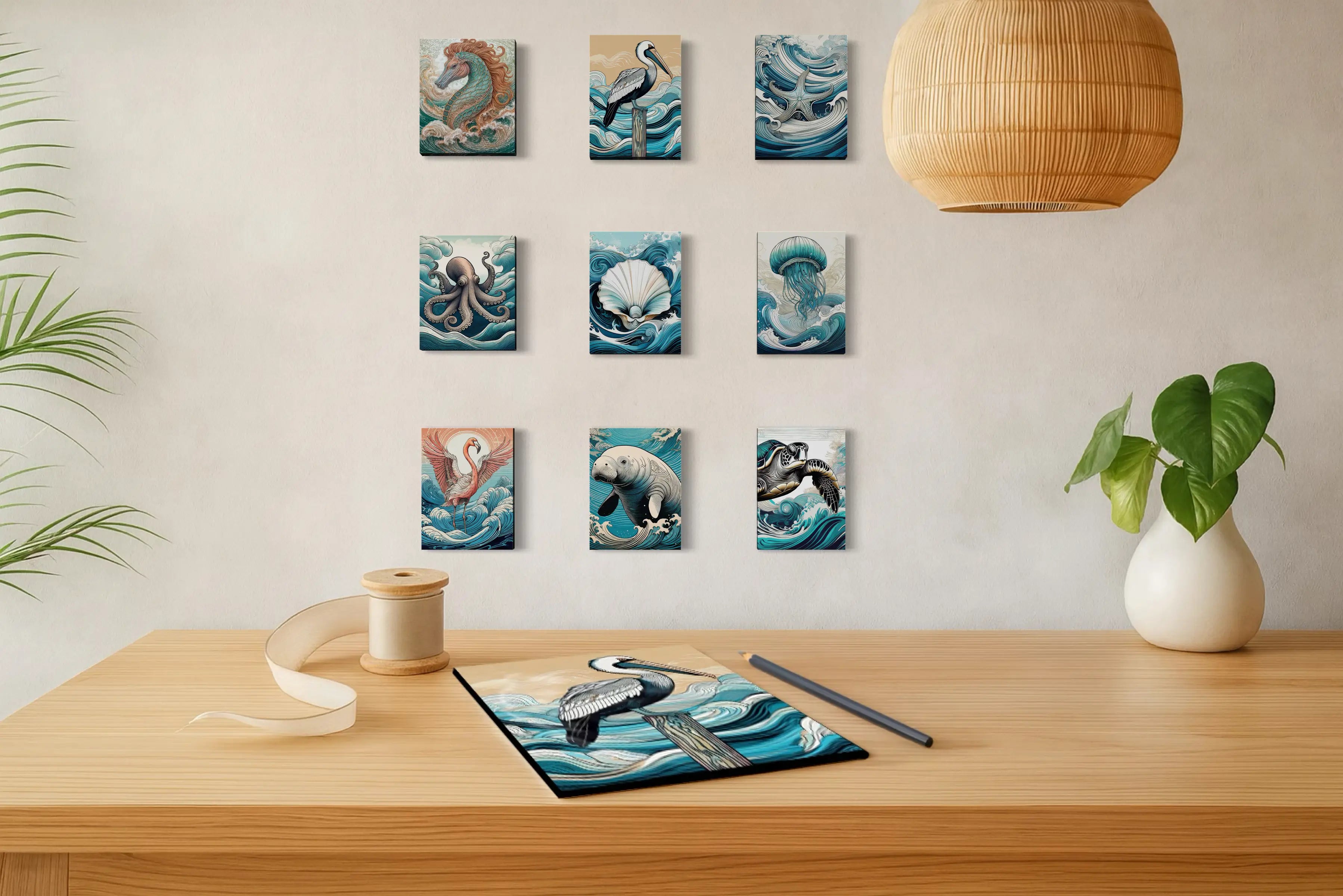
A black-and-white marsh photograph can live beside a stylized blue heron print.
Shell photography can sit comfortably above sage bedding or beside charcoal pillows.
A dramatic coral still life can anchor a pale room without making it feel heavy.
The absence of color in the artwork does not make the room colorless. It gives the room more freedom.
For additional styling ideas, visit Coastal Living Room Wall Art | Large & Statement Prints.
The same qualities that make coastal photography so compelling in black and white—light, reflection, tonal depth, and texture—also make it especially suited to glass.
The Coastal Black & White Glass Prints collection is printed directly onto real, frameless glass using eco-friendly UV inks. The inks provide fade resistance and lasting clarity, while the glass gives each image a luminous, museum-quality presentation.
Glass enhances texture and dimension.
That matters especially in photographs built around shell ridges, coral folds, sea urchin patterns, weathered wood, cloud layers, and reflective water. Fine details remain visible, while the polished surface gives the image a clean, contemporary presence.
Gentle reflections shift subtly as the light changes throughout the day. The photograph itself remains still, but its presence in the room can feel responsive.
The surface does not turn the image into water, but its luminosity recalls the way wet sand, shells, and calm tidal pools hold light.
The frameless presentation keeps the artwork visually light. Without the added weight of a traditional frame, the image feels clean, sculptural, and almost floating on the wall.
To learn more about the material itself, visit the Why Glass? guide or read Why Glass Wall Art Elevates Coastal Interiors.
The still-life pieces are where I feel closest to the coast’s hidden architecture—where every ridge, fold, spiral, and porous surface begins to speak.
Seashell Chorus brings together a fan-shaped shell, coral forms, and a starfish against a deep black background. Fine shell ridges, coral surfaces, and reflected shapes create a layered study of natural structure.
Coral Gathering places spiral shells within mushroom coral, framed by cauliflower and lettuce coral. Rounded surfaces meet ruffled folds, and the arrangement becomes a landscape of repetition, depth, and shadow.
Pearl Nautilus Cove pairs the luminous curve of a pearl nautilus with mushroom coral, brown stem coral, and sea urchin shells. The smooth spiral of the nautilus contrasts with branching coral and the repeated geometry of the sea urchins.
In Sea Fan Stillness, a delicate sea fan rises behind a sea biscuit and Merulina coral. The sea fan’s lace-like structure feels almost weightless beside the broader, more sculptural reef forms.
Shell & Bloom brings the shoreline into conversation with the garden, pairing orchid blossoms with the broad spiral of a Giant Tun Shell, Tonna galea. Petals and shell curves meet in a composition that feels botanical, coastal, and quietly dramatic.
Each piece begins with recognizable natural subjects. In black and white, they also become studies in rhythm, shape, shadow, and layered texture.
For more on coral as structure and form, read Behind the Art: Finding the Architecture of the Sea in a Piece of Coral.
For a deeper look at the use of black backgrounds, visit Why Dark Backgrounds Work So Well in Coastal Wall Art.
Texture is not limited to shells and coral.
Weathered driftwood carries the history of wind, water, time, and tide across its surface. Grain, hollows, roots, and worn edges can transform a shoreline remnant into something almost architectural.
Beach and marsh landscapes reveal texture on a wider scale.
Foam traces the movement of water. Wet sand holds the sky. Dunes and sea oats interrupt open horizons with delicate line. Marsh grasses divide reflection from reflection, while clouds create tonal layers across both sky and water.
These broader scenes give the collection space to breathe. They balance the concentrated detail of shell and coral studies with openness, atmosphere, and distance.
A close photograph asks the eye to move inward.
A landscape allows it to travel outward.
Both are ways of experiencing the coast.
The collection grew from many different ways of looking at the sea.
Some photographs move close enough to reveal the smallest ridges of a shell or the repeated markings of a sea urchin. Others step back toward open beaches, weathered driftwood, reflective marshes, and cloud-filled skies.
Together, they show how varied monochrome coastal art can feel—sculptural or atmospheric, intimate or expansive, quietly luminous or filled with contrast.
The selected works below carry some of the textures, forms, and moods explored throughout this article.
A single large print can anchor a sofa, bed, console, dining area, or office wall. Beach and marsh photographs work especially well when a room needs a greater sense of openness, while shell, coral, and driftwood studies create a stronger focal point through texture and contrast.
A coordinated pair brings balance without feeling overly formal. Two pieces can share similar tones while showing different subjects, allowing them to feel connected without becoming repetitive.
For a wider wall, three prints can introduce rhythm and scale. A shell triptych is a natural extension of the collection, with repeated curves, related textures, and consistent black-and-white tones unfolding across the wall as one larger visual story. Explore more coastal diptych, triptych, and multi-panel glass wall art designed for larger walls.
If you are deciding whether your own space would work better with one large piece, a diptych, a triptych, or a coordinated set, see How to Decorate a Large Wall with Diptych, Triptych & Multi-Panel Art.
The pieces do not need to match exactly. Shared elements—monochrome tones, dark backgrounds, glass surfaces, organic forms, or coastal locations—can connect detailed still lifes with quieter landscapes.
Balance is often more important than sameness.
The Black & White Nautilus Shell Triptych on Glass is one example of that approach, using chambered, pearl, and paper nautilus shells, coral, starfish, and sea urchins across three coordinated panels.
One Print: A Clear Focal Point A Pair: Balance and Conversation Three Prints: Rhythm Across a Wider Wall


What is black-and-white coastal wall art?
Black-and-white coastal wall art uses monochrome photography or artwork to interpret shoreline subjects such as shells, coral, waves, beaches, driftwood, sea life, dunes, and marshes. Without color taking the lead, form, texture, contrast, and atmosphere become more prominent.
Why do shells, coral, and sea urchins work so well in black and white?
These subjects contain strong natural patterns and layered textures. Shell ridges, coral folds, branching forms, and sea urchin markings become easier to notice when color is removed. Black and white emphasizes their geometry, surface detail, and sculptural qualities.
Does black-and-white coastal art work in a room with an ocean or marsh view?
Yes. Monochrome coastal art can complement a view without competing with its color and movement. Close studies of shells, coral, or driftwood add structure and texture, while black-and-white landscapes echo the atmosphere outside in a quieter way.
What interior styles work with black-and-white coastal wall art?
Black-and-white coastal wall art works well in modern coastal, contemporary, minimalist, organic-modern, Japandi-inspired, neutral, and coastal-noir interiors. Its restrained palette also pairs easily with slate blue, charcoal, sage, ivory, sand, and natural wood.
Why print black-and-white coastal photography on glass?
Glass enhances texture and dimension while giving the photograph a luminous, frameless presentation. Gentle reflections interact subtly with changing room light, and eco-friendly UV inks provide fade resistance and lasting clarity.
Should I display one print, a pair, or a triptych?
A single large print works well as a focal point. A coordinated pair creates balance above a bed, sofa, or console. A triptych is especially effective on a larger wall where repeated shell forms, related textures, or connected landscapes can create rhythm and scale.
Is black-and-white coastal wall art only for beach houses?
No. Monochrome coastal art can work anywhere a room would benefit from organic form, quiet contrast, and natural texture. It can suggest the coast without relying on obvious beach themes or nautical decor.
What is the difference between black-and-white coastal photography and coastal noir?
Black-and-white coastal photography can range from soft, pale, and meditative to bold and dramatic. Coastal noir generally emphasizes deeper shadows, stronger contrast, dark backgrounds, and a more atmospheric or cinematic mood.
The coast is often remembered in color: blue water, pale sand, green marsh grass, pearly shells, and changing skies.
But in black and white, another coastline appears.
Texture moves forward. Light becomes more deliberate. Familiar subjects feel newly sculptural. A shell can hold the eye as strongly as a horizon, and a small section of coral can contain an entire world of folds, ridges, and shadow.
Black-and-white coastal photography does not ask the sea to become less vivid.
It asks us to look more closely.
In that closer view, the shoreline reveals its quiet drama—layer upon layer of texture, form, weather, reflection, and time.
If the quiet strength of monochrome coasts speaks to you, explore the complete collection of glass prints shaped by shell spirals, coral architecture, weathered surfaces, open water, and shifting coastal light.
About the Author — Lisa Reid
Lisa Reid is the photographer, artist, and founder of Echoes of the Sea LLC. Her coastal glass wall art is shaped by time spent observing shells, coral, birds, waves, driftwood, and tidal landscapes—often with an eye for the quieter details that color can conceal.
Through her artwork and The Coastal Journal, she explores how natural form, shoreline light, reflection, and texture can bring a deeper sense of calm and connection into the spaces where we live.


