

How Seashells Are Formed: Spirals, Ridges, Color, and Time
|
|
Time to read 15 min
Cart
Your cart is empty
|
|
Time to read 15 min
A shell can look as though it arrived complete.
We find it at the tide line already carrying its curve, ridges, bands of color, and the softened edges left by water and sand. It may fit easily in the palm of a hand, yet its surface holds a history we did not witness: growth, protection, movement, weathering, and sometimes repair.
A shell is not decorated after it is made.
Its beauty is built into the way it grows.
That may be part of why seashells feel so different from ordinary objects. They are natural architecture, created slowly by a living animal and shaped further by the sea. Long after the animal is gone, the shell remains as a record of form, pattern, and time.
Table of contents
Seashells are formed by mollusks, a large group of animals that includes snails, clams, oysters, mussels, scallops, and nautiluses. by mollusks, a large group of animals that includes snails, clams, oysters, mussels, scallops, and nautiluses.
A specialized tissue called the mantle builds the shell through a process known as biomineralization. The mantle releases proteins and other organic materials that create a framework, then combines them with minerals—primarily calcium carbonate—to form a hard protective structure. Woods Hole Oceanographic Institution offers a clear explanation of how mollusks build seashells from proteins, calcite, and aragonite.
Calcium carbonate can crystallize in different forms, most commonly calcite and aragonite. Many shells contain one or both, arranged in layers that give the shell different qualities of strength, texture, and shine.
Some shells also have a thin organic outer layer called the periostracum, which helps protect the surface and provides a framework over which mineral growth can occur. In certain species, the innermost layer forms nacre, or mother-of-pearl, whose finely arranged crystals create its familiar iridescence.
The shell is not something the animal later finds or moves into. In most shelled mollusks, it is built as part of the animal’s body and grows with it.
In simple terms: a mollusk builds its shell layer by layer as it grows.
A shell does not expand evenly in every direction.
New material is added along the growing edge. In a snail, this usually happens around the opening. In clams, mussels, and scallops, growth spreads outward along the edges of the two valves.
Older portions remain in place while each new addition gives the animal more room. That is why a shell can preserve its earliest growth while continuing to expand around it.
Some increments are visible on the surface. Others remain within the shell’s internal structure. Some visible lines reflect periods of growth, but they are not always simple yearly rings. Shell growth may respond to tides, seasons, temperature, food availability, reproduction, stress, injury, and other environmental conditions. The Australian Academy of Science explains how shell growth bands can preserve a record of the animal’s life and surrounding environment.
A shell grows through repeated additions, but not always evenly.
Spiral shells form because new material is added in a repeating pattern around an expanding opening.
As one part of the growing edge develops at a slightly different rate from another, the shell begins to curve and coil. Each new section wraps around the earlier growth, preserving what came before while creating more room for the animal.
This is seen in many gastropods, including whelks, moon snails, and conchs. Nautiluses also grow in a spiral, but they add a sequence of internal chambers as they expand.
Not every spiral follows the golden ratio, and nature is rarely as mathematically perfect as simplified diagrams suggest. Still, expanding curves and repeated proportions often create a form that feels naturally balanced.
We can see the earlier shell held inside the later one.
Growth does not erase what came before. It circles around it.
Ridges and surface details form as the mantle deposits new material along the growing edge.
Some reflect the rhythm of growth. Others are inherited features of the species. Depending on the mollusk, the shell may develop fine lines, broad ribs, fluted edges, knobs, spines, or overlapping layers.
These structures are not simply decoration. Some add strength without requiring the entire shell to become heavier. Others help the animal settle into sand, break up its outline, resist predators, or respond to the conditions of its habitat.
A scallop opens outward in radiating ribs. An oyster builds rough, irregular layers shaped partly by the surface beneath it. A whelk may carry raised spiral lines around its body. A nautilus appears smooth from the outside while holding chambers within.
What looks ornamental to us was built through growth, protection, and adaptation.


Shell color is created as the shell grows.
Pigments produced along the mantle edge become incorporated into the new material. Depending on when and where those pigments are released, they may form stripes, spots, flames, spirals, bands, or irregular patches.
The pattern develops as the shell grows, following the expanding edge and the rhythm of pigment deposition.
Genetics plays a major role in shell color and pattern, while diet, habitat, water chemistry, temperature, and growth conditions may influence how those colors are expressed. Pigments deposited by the mantle can produce browns, blacks, reds, oranges, pinks, and purples, while microscopic shell structures create iridescence by reflecting light.
In some mollusks, pigments obtained through food may contribute to shell color, but diet does not explain every pattern. The same species may also vary according to its environment, age, and individual growth history.
No single explanation accounts for every shell. Some vivid colors appear inside shells where they would not serve as visible camouflage. Others occur in deep water where little light reaches them.
Shell color is one of the places where biology still leaves room for mystery.
After the shell is empty, sunlight, sand, water, and time may soften its colors. A shell that was once vivid may reach shore pale, weathered, or nearly white.
The shell we find is both a biological structure and a coastal object changed by the sea.


A shell does not preserve time in the way a clock does.
It records it through accumulation.
Each new layer was once the growing edge. Ridges, color changes, repaired breaks, worn surfaces, and changes in thickness can preserve evidence of the animal’s life and environment.
Some shells contain growth increments influenced by tidal or seasonal cycles. Their chemistry may also hold traces of temperature, salinity, pollution, and other environmental conditions.
Scientists study these records much as they study tree rings, although shell growth is not always as straightforward to interpret.
Damage can also become part of the record. A crack may be repaired with new material. A broken edge may expose inner layers that would otherwise remain hidden. A worn surface may show years of movement through sediment and surf.
These marks are not flaws added to an otherwise perfect object.
They are part of its story.
A shell’s usefulness does not always end when the animal dies.
Oyster shells can become the foundation for new oyster reefs. Young oysters, known as spat, need a hard surface on which to settle, and existing oyster shell provides one of the best places for them to attach. As new oysters grow on living and dead shells, the reef gradually builds upward and outward.
In Florida, the FL.O.O.R. program—Florida Oceanographic Oyster Restoration—uses shells collected from local restaurants to help rebuild oyster habitat in the St. Lucie Estuary and Indian River Lagoon. Instead of being sent to landfills, the shells are placed on the estuary floor, where they become substrate for new oysters.
Those reefs support more than oysters. They create habitat for fish and marine invertebrates, filter particles and nutrients from the water, and help soften wave energy that might otherwise contribute to shoreline erosion.
According to Florida Oceanographic Society, the program has restored nearly 60,000 square feet of oyster reef with the help of local restaurants and thousands of volunteer hours.
A discarded shell becomes structure. Structure becomes habitat. Habitat becomes a living reef.
The shell’s first life may be over, but its role in the coast is not.
Part of the beauty of a shell lies in its structure. We are drawn to repeated curves, fine ridges, balanced asymmetry, and the quiet order found in natural forms. Spirals expand with grace. Color repeats without becoming mechanical. Texture catches light differently each time the shell is turned in the hand.
But pattern alone is not the whole story.
Shells also feel personal because they are discovered.
We notice one at the tide line, lift it from the sand, turn it over, and recognize something in it—its curve, color, wholeness, broken edge, or simply the feeling that it waited there to be seen.
That act of finding matters.
It is why people return from the beach with pockets full of shells, why collections gather in jars and bowls, and why shelling becomes a lifelong pleasure for so many. Each shell carries not only the structure created by the animal, but also the memory of the place where it was found.
A shell may recall a child’s hand, a morning walk, a particular island, or a quiet hour spent watching the tide.
Some are complete. Some are broken. Some have been worn almost smooth. Yet even a fragment may feel worth keeping.
Perhaps that is because a shell holds several kinds of meaning at once: pattern, history, touch, discovery, and place.
It is a small piece of natural architecture delivered by the tide.
Shell patterns combine order with variation.
A manufactured pattern may repeat exactly. A natural pattern repeats while changing. Each ridge follows the one before it, but small differences in growth, pigment, texture, and proportion keep the form alive.
This balance appears throughout the coast—in branching coral, water, clouds, sea oats, and the interior chambers of a nautilus. There is structure, but not rigidity. Repetition, but not sameness.
That may help explain why these forms feel so comfortable in a room. The repeating structures found in shells and coral are explored more deeply in Fractals in Nature: Why Shells, Coral, and Nautilus Patterns Feel So Calming, while the expanding curve of the shell connects naturally to Why the Fibonacci Spiral Is Nature’s Most Beautiful Pattern.
A shell spiral gives the eye a path to follow. Ridges create rhythm. Curves soften the harder lines of walls and furniture. Even a black-and-white shell study still feels connected to nature because the form carries evidence of movement and growth.
The same structures that helped the shell grow are also the qualities that make shell imagery easy to live with: repetition, balance, curve, and variation. Together, these forms belong to the larger Architecture of the Sea—the natural structures, patterns, and rhythms that shape shells, coral, waves, and other coastal forms. This is one reason shell forms work so beautifully within biophilic design for coastal homes.
A shell found on the beach may first appear small and familiar.
Placed beneath careful light, it changes.
The curve becomes architectural. Fine ridges create shadow. A spiral leads inward. A broken edge may reveal inner layers—and, in chambered shells, spaces that were hidden while the shell was whole. Pearly surfaces reflect softly, while pale shells and coral become almost luminous against a dark background.
Photography allows these details to remain still long enough to be seen differently.
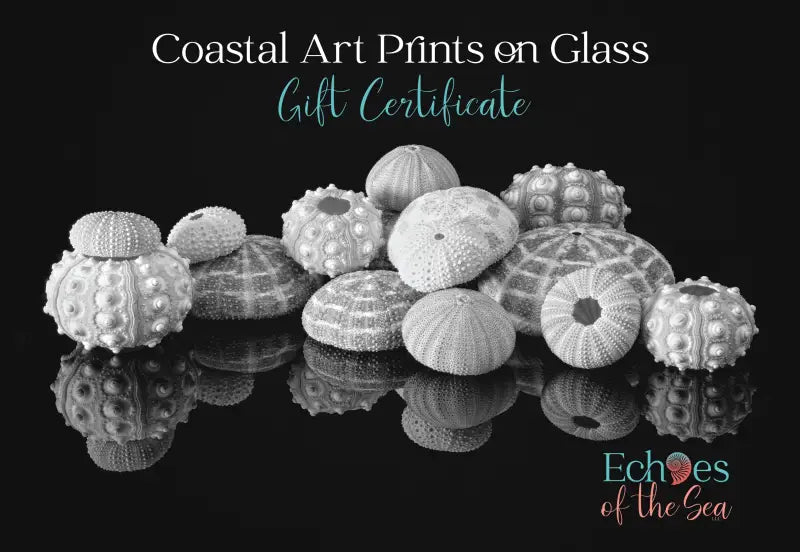
A close study removes the shell from the visual complexity of the shoreline and gives its structure more space. Against black, a pale shell may feel sculptural and dramatic. Against a lighter background, its fine lines and gentle variations become quiet and precise. Reflection can double the form, creating a conversation between the shell and its mirrored shape.
This is where the shell moves from collected object to art.
The subject remains natural, but light, scale, arrangement, and surrounding space invite us to notice what may have been overlooked in the hand.
A shell is already a work of art.
Photography gives us another way to enter it.
Shell imagery does not have to make a room feel themed or overly nautical.
Used thoughtfully, it can bring organic form, natural rhythm, texture, and a sense of collected history into an interior.
A nautilus, scallop, coral branch, or shell interior can be appreciated first as form.
Look for curve, chamber, ridge, reflection, and shadow rather than relying on obvious beach motifs. A strong shell study can feel at home in modern, organic-modern, minimalist, contemporary, or transitional spaces because its appeal begins with shape and structure.
Black-and-white shell photography feels sculptural and graphic. It can anchor a pale room, add depth to neutral walls, and introduce coastal form without strong color.
Pearl, cream, sand, and soft gray create a quieter mood. These palettes work beautifully in bedrooms, reading areas, entryways, and spaces where the goal is calm rather than contrast.
A shell that fits in the hand can become surprisingly powerful when photographed at a larger scale.
Enlargement reveals details that might otherwise go unnoticed: growth lines, chambers, ridges, repairs, and fine surface texture. One substantial image may create more presence than a shelf full of smaller decorative objects.
Triptychs work especially well when the images share a visual language—three shell studies, multiple views of one form, or a combination of shell, coral, and reflection.
Shell forms are intricate. They benefit from space.
A clean, frameless presentation allows the structure to remain the focus. Printed on glass, the fine ridges, deep shadows, and pale surfaces gain clarity and dimension. Reflections change gently with the room’s light, echoing the shifting shimmer of shells near water.
The goal is not to fill every surface with coastal objects.
It is to let one meaningful form carry the connection.
Shell art carries more than coastal subject matter.
It carries evidence of how nature builds: slowly, repeatedly, and without separating beauty from function. Spirals hold earlier growth within later curves. Ridges reveal movement across time. Color follows the expanding edge. Wear and repair become part of the final form.
A nautilus interior study may suggest order and continuity. A black-and-white shell composition can introduce structure and quiet drama. A softer shell arrangement may evoke discovery, memory, and the intimacy of something collected by hand.
Explore coastal glass prints inspired by the architecture of shells—their spirals, chambers, ridges, reflections, and patterns shaped over time.
A shell begins as part of a living animal.
It is built layer by layer, extended as the animal grows, colored as pigment is deposited, and shaped by a biological pattern carried across generations.
Then, sometimes, it enters another life.
The empty shell moves through water. Its surface wears. Its color softens. Sand works into the edges. The tide carries it until it arrives somewhere visible among foam, coral fragments, driftwood, and other pieces of the shore.
Someone notices it.
Someone bends down and lifts it from the sand.
That moment completes no scientific process, but it begins a human one: memory, curiosity, collecting, art, and the desire to keep something of the coast close.
A seashell is built by an animal, shaped by the sea, and given new meaning by the person who finds it.
Perhaps that is why shells continue to hold our attention. No two are exactly alike. Each one carries its own spiral, texture, color, pattern, and history — a small work of art shaped by life and time.
Seashells are formed by mollusks. A part of the animal called the mantle releases an organic framework and minerals, mainly calcium carbonate, which harden into shell material. New layers are added as the animal grows.
Most seashells grow by adding new material around the shell’s opening or outer edge. Older parts remain in place while the growing edge expands, allowing more space for the animal.
Seashells are made largely of calcium carbonate combined with an organic protein-based framework. The exact structure and mineral form can vary among different groups of mollusks.
Spiral shells form as the mollusk adds new material around an expanding opening. Unequal growth around the shell causes it to curve and coil, with each new section wrapping around earlier growth.
Pigments released by cells along the mantle edge are incorporated into the shell as it grows. Differences in when and where those pigments are deposited create bands, spots, stripes, and other patterns.
Yes. In most shelled mollusks, the shell is part of the animal and grows with it. The mollusk continues adding material as its body becomes larger.
Some visible lines and ridges reflect periods of shell growth, but they are not always exact annual rings. Growth may be affected by season, food availability, reproduction, stress, injury, and environmental conditions.
Shell form is strongly influenced by species and genetics, but environmental conditions, age, growth rate, damage, repair, and weathering can create individual variation.
Rules vary by location. Empty shells may be collected in some places, while parks, protected beaches, and wildlife areas may prohibit removal. Never take an occupied shell, and check local regulations before collecting.
Empty shells may be worn down by waves and sand, become part of beach sediment, or continue supporting marine life. Oyster shells can provide hard surfaces where young oysters settle, helping new reefs form.
Tropical shells are often especially varied in color and form. Possible influences include genetics, diet, habitat, camouflage, predator pressure, and the greater diversity of species found in warm waters. No single explanation accounts for every shell pattern.
About the Author
Lisa Reid is the photographer and creative force behind Echoes of the Sea LLC, where coastal photography, natural form, and thoughtful interior design come together.
Her shell studies are inspired by the architecture hidden in familiar shoreline objects: spirals, chambers, ridges, coral branches, reflected forms, and the fine details revealed through careful light. She is especially drawn to the individuality of shells—the way each one carries its own textures, patterns, colors, and history.
Through luminous glass wall art, Lisa creates pieces designed to bring the structure, memory, and emotional presence of the coast into everyday spaces.
For Lisa, photographing a shell is not only about preserving what was found on the shore. It is about revealing what time and growth built within it—and honoring each shell as a small, singular work of art.


