
From Stillness to Warm Currents: What Florida’s Manatees Teach Us About Gentle Strength
|
|
Time to read 5 min
Cart
Your cart is empty
|
|
Time to read 5 min
Florida manatee meaning centers on gentle strength, resilience, and calm persistence. Observed in warm springs and coastal refuges, manatees symbolize patience, adaptation, and quiet presence. In coastal art, they represent emotional steadiness and the power of moving through life without force.
A reflection on calm, resilience, and the gentle strength of Florida’s manatees.
Through misty mornings and sunlit currents, Florida’s manatees remind us what it means to move slowly and live deeply. Their quiet grace and resilience mirror the luminous calm that inspires every piece of Echoes of the Sea glass art — patience, balance, and light.
Shop the Manatee Collection
Discover More Coastal Glass Prints
Read More on The Coastal Journal
It snowed that day — rare for Florida.
The air still carried that cold hush when I stepped onto the boardwalk at Manatee Springs State Park.
The water below stayed warm, a constant 72°F, sending silver steam drifting through the cypress trees. It was still, except for the occasional bubbling sound from the springhead.
I didn’t see the manatees right away. Only ripples. Only reflections.
Sometimes timing works against you — and sometimes it teaches patience.
That morning reminded me that nature’s rhythm can’t be rushed. The moment you stop chasing it, the beauty reveals itself.
A few days later, I stood at the TECO Manatee Viewing Center near Apollo Beach.
The scene was completely different — alive with motion.
Dozens of Florida manatees glided through the shallow water, rising just long enough to breathe before drifting back beneath the surface.
Their shapes blurred the line between shadow and light — soft curves in warm current.
For decades, the Big Bend Power Station’s warm-water discharge has provided a unique winter refuge — one born by accident, but sustained through conservation partnerships and careful monitoring.
When manatees first gathered in its warm outflow, TECO took notice — and took responsibility.
By 1986, the company worked with state and federal agencies to create a protected sanctuary and educational site.
Today, it’s both a sanctuary and a learning space — a place where families, photographers, and conservationists gather to witness the quiet harmony between industry and ecology.
It’s a rare balance — a reminder that progress and preservation don’t have to be opposites.
Nature adapts — and sometimes, so do we.
Many of these manatees return to this same place year after year, guided not by maps or markers, but by memory. They remember where the water stays warm when the air turns cold — a quiet migration rooted in survival and trust.
Standing there, it’s impossible not to feel our role in their story.
Not as controllers of nature, but as caretakers — responsible for observing, protecting, and learning rather than interfering.
Watching manatees quietly changes how you see them — and yourself.
Watching manatees surface and drift beneath the water reveals a rhythm that feels almost forgotten.
To capture a moment like this, you have to see beneath the surface first.
A moment of calm, intention, and quiet connection — gone almost as soon as it appears.
Their movement is unhurried, deliberate, and deeply grounding.
Manatees move with intention, not urgency. Watching them, I thought of how strength can be silent — how beauty doesn’t demand attention; it simply exists.
That same philosophy shapes my approach to art.
Working with glass means working with patience — letting light shift and reflection find its own rhythm.
Like the manatee, my goal isn’t speed; it’s harmony.
In that soft current outside Tampa Bay, I found a new meaning in what I create:
Art that reflects not just light, but resilience, rhythm, and renewal.
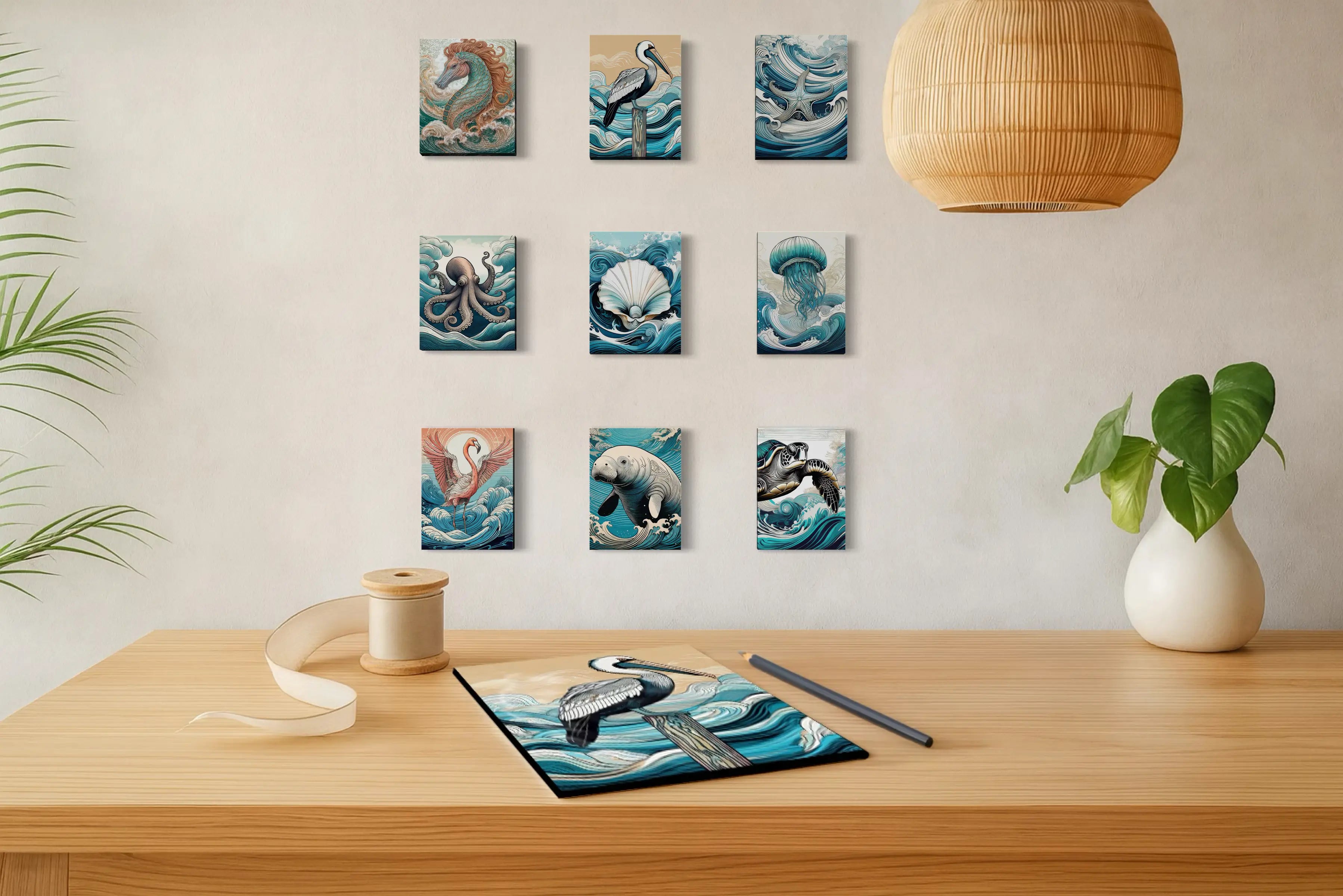
This whimsical glass print blends Japanese wave artistry with coastal calm — a symbolic balance between strength and serenity.
It’s one of my personal favorites because it captures that same quiet energy I felt watching the manatees drift beneath the surface — motion without rush, presence without demand.
Luminous frameless glass prints inspired by the still waters of Florida’s bays and springs.
Florida manatees are a subspecies of the West Indian manatee — found year-round in Florida’s rivers and coastal waters.
In winter, they gather in warm refuges like Manatee Springs, Blue Spring, and TECO Big Bend.
The water remains a steady 72°F, creating the striking mist you see on cold mornings.
As older coal-fired plants close, conservation efforts are expanding natural spring restoration and alternative warm-water strategies to support long-term manatee survival.
They’re herbivores — eating up to 10% of their body weight daily in seagrass, maintaining coastal balance.
Watching manatees in these warm-water refuges isn’t spectacle — it’s an invitation.
An invitation to slow down, observe quietly, and recognize how deeply connected we are to the environments we shape.
To me, the Florida manatee symbolizes presence — not in a loud, forceful way, but through quiet strength.
They embody balance, patience, and resilience — the same qualities that bring harmony to a coastal home or a piece of luminous art.
Their rhythm is our reminder:
To pause.
To breathe.
To move through life with calm persistence.
The manatee is one of many coastal creatures explored in our Coastal Symbolism guide, where we uncover the deeper meaning behind sea life, shoreline birds, shells, and natural ocean forms.
Inspired by the quiet strength of Florida’s manatees, these luminous glass prints are designed to reflect light, movement, and serenity — just like the waters they were born from.
Frameless. Luminous. Coastal calm you can feel.
Explore art inspired by still water and gentle strength.
They were recently reclassified as “threatened,” though conservationists warn the fight isn’t over. Habitat loss and cold stress still pose major risks.
Popular viewing spots include Manatee Springs, Blue Springs, Crystal River, 3 Sisters Springs,and TECO Manatee Viewing Center.
Our Manatee Glass Prints are available in multiple sizes, from small accent pieces to large statement art. Each size is designed to maintain clarity, depth, and balance when printed on glass.
Each glass print arrives ready to hang with a concealed foam-core backing and keyhole mount. The system allows the artwork to sit flush against the wall while remaining secure and easy to install.
Yes. Each piece is UV-printed directly onto glass, preserving fine detail, rich color, and the reflective qualities that make glass art feel alive as light changes.
Glass naturally reflects its environment — part of its beauty. Depending on lighting and time of day, reflections may shift subtly, enhancing depth and movement without obscuring the artwork.
About the Artist
Lisa, founder of Echoes of the Sea, blends fine art and coastal design to create luminous glass prints that capture the serenity and rhythm of the ocean.
Each piece begins as original photography or painting and becomes a study in reflection, patience, and natural calm.


